Drosophila Immune Enhancer Atlas
Citation: Cohen LB, Hadzic T, Sauer C, Gibbs JR, Wunderlich Z (2026). A genome-wide survey reveals a diverse array of enhancers coordinates the Drosophila innate immune response. Genome Research. https://doi.org/10.1101/gr.281432.125. Epub ahead of print. PMID: 41985990.
To defend against microbes, animals regulate a complex immune response. The Drosophila innate immune system deploys a large transcriptional induction of signaling proteins, anti-microbial effectors, and other critical immune factors. This transcriptional response is encoded in enhancers, cis-regulatory sequences that modulate gene expression by binding transcription factors (TFs). While enhancers and transcription factor binding sites (TFBS) have been identified for several immune responsive genes in Drosophila, most enhancers that regulate immune-induced genes are unknown. By identifying enhancers, we can understand how their composition controls expression and contributes to infection outcome. We employed STARR-seq (Self Transcribing Active Regulatory-Region sequencing) in a hemocyte-like cell line to identify immune-specific enhancers across the D. melanogaster genome and performed ATAC-seq in hemocytes extracted from adult flies to assess the chromatin state of these enhancers before and after immune stimulus. We identified thousands of enhancers responsive to IMD stimulation, one of the two primary immune signaling pathways in Drosophila. As expected, immune enhancers are enriched for motifs of Relish, an NF-kB factor, and Kay/Jra, a bZip heterodimer pair, involved in the Imd and JNK pathways respectively, compared to enhancers active in unstimulated cells. However, when grouping enhancers by their target gene's expression timing or functional role or by the enhancers' chromatin accessibility pre- or post-stimulus, different groups of TFBS motifs are enriched, suggesting distinct regulatory logic for different parts of the immune response. Identification and characterization of the diverse array of enhancers that regulate the innate immune response expands our understanding of how animals fight infections.
This platform is the Wunderlich Lab’s web resource for querying and visualizing enhancers identified through STARR-seq in Drosophila melanogaster S2* cells. The database enables researchers to explore enhancer activity across three experimental conditions: Control, 20E hormone treatment, and IMD immune treatment.
The Drosophila Immune Enhancer Atlas integrates high-throughput STARR-seq data with gene expression and functional annotation information. There are two types of enhancer data contained within. The first enhancer dataset contains all the enhancers identified in each treatment condition and can be searched by genomic position or by associated genes. The second enhancer data is more processed, and sorts enhancers by whether they are detected in just one, two, or all three conditions, termed "activity classes". The database allows users to:
Use this option when you have a Genomic Region and want to Identify Enhancers and their Associated Genes.
Steps:
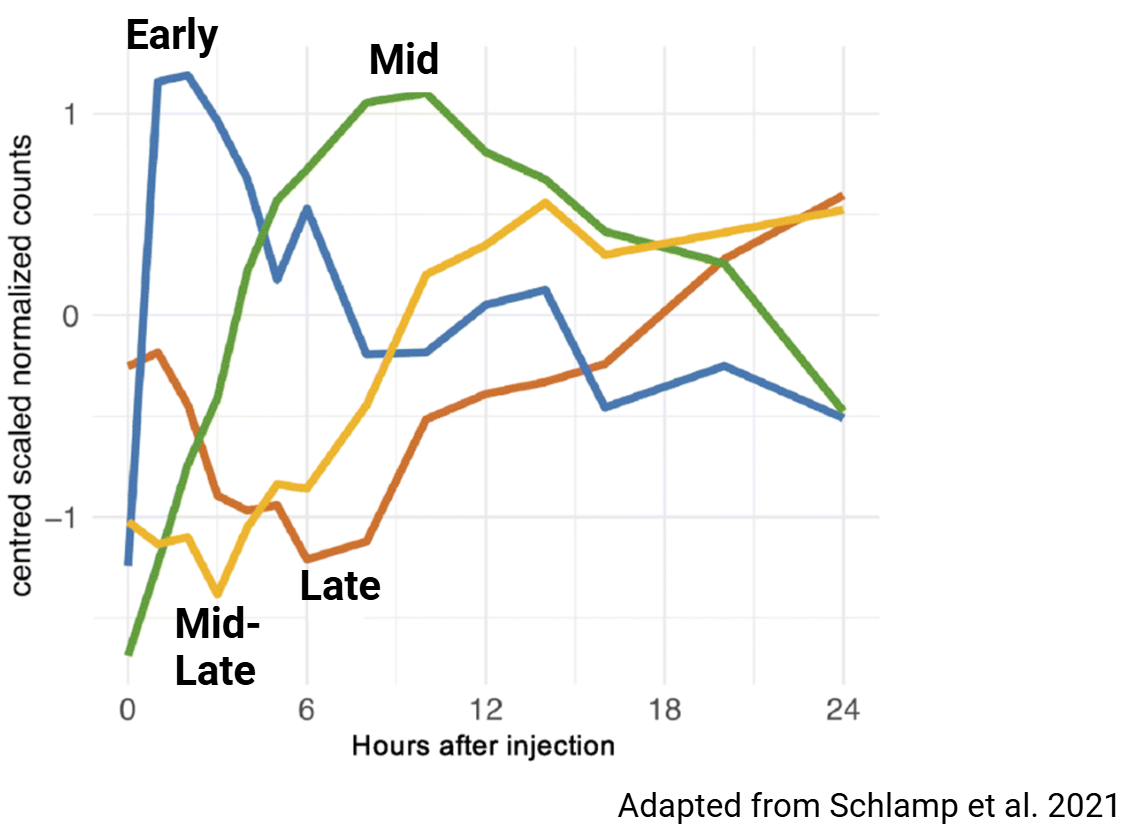
Mean expression of four main clusters of immune responsive genes across first 24 hrs post stimulus from Schlamp et al 2021.
Use this when you have a Gene of Interest and want to Find its Assigned Enhancers.
Steps:
Use this to Find Activity Class Enhancers with Specific Regulatory Properties.
Steps:
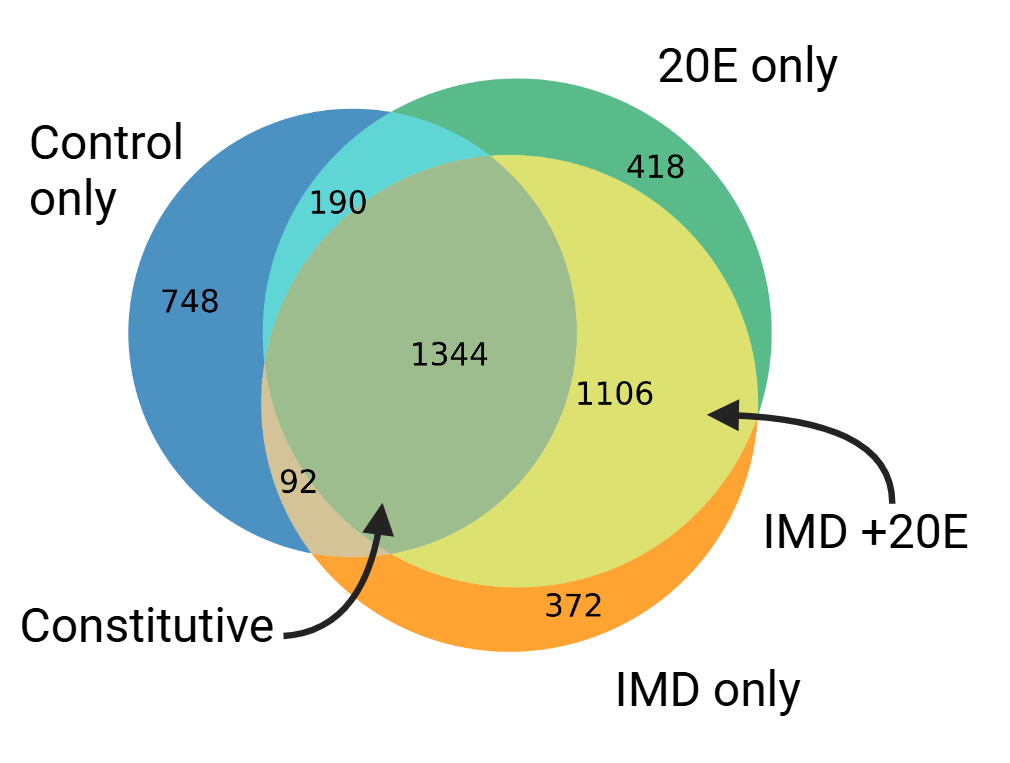
Distribution of enhancers across different activity classes, including overlaps between enhancers active under multiple experimental conditions.
The database contains STARR-seq data from S2* cells treated under three conditions:
Each entry includes:
Access the full dataset in the NCBI Gene Expression Omnibus under accession number GSE308695
For questions about this database or the underlying data, please contact the Wunderlich Lab.
Dr. Zeba Wunderlich: zeba@bu.edu
This database was created with data provided by the Wunderlich Lab. We thank Dr. Zeba Wunderlich and Dr. Lianne Cohen for their support and guidance.
This website was originally developed by Anushka Dongaonkar, Yuki Ito, Gary Twu, and Jahnavi Kodali as part of the course
BF768 Biological Database Systems at Boston University, facilitated by Dr. Gary Benson.
Following the course, Anushka Dongaonkar continued to expand and maintain the project.
Example coordinates: 2L, start: 10426653, end: 10427192 | Example enhancer: 2R:16125955-16138021
Example coordinates: 2L, start: 3452301, end: 3452810 | Example enhancer: 2L:3452301-3452810